Actuarial backbone
A 25-year-old male has ~2,704 weeks remaining; female ~2,927.
SSA Period Life Table 2022
See what your habits multiply to across your remaining life.
SSA Period Life Table 2022
Quoidbach, Gilbert & Wilson 2013, Science
Brysbaert 2019, J Memory & Language
Lally et al. 2010, Eur J Soc Psychol
The cultural meme says about 4,000 weeks for an 80-year life. The actuarial math says something more specific. Per the Social Security Administration's Period Life Table 2022, used in the 2025 Trustees Report, a 25-year-old male has roughly 2,704 weeks remaining; a 25-year-old female roughly 2,927. A 35-year-old female has about 2,437. A 45-year-old male about 1,790. The personal-accurate number is almost always less than the cultural-meme average, because the meme uses a hopeful 80-year framing and the actuarial data uses observed 2022 mortality rates. Your gender and your age both move it more than people realize. That's the first thing this tool does: it gives you the specific number for your specific you, not the round-figure version.
Per Quoidbach, Gilbert, and Wilson's 2013 study in Science, more than 19,000 people aged 18 to 68 were asked how much they had changed in the previous decade and how much they expected to change in the next one. People at every age underestimated how much they would change in the next decade by roughly the same amount they had been surprised by how much they had already changed. The illusion holds across the lifespan; young adults are the textbook case. If you're 22 to 28 and the math of your current daily habits multiplied across the next 50 years feels impossibly large, that's the illusion talking — not a calculation error. The Default-You column in this tool is the math your future-self forecasting doesn't catch.

Per Brysbaert's 2019 meta-analysis in the Journal of Memory and Language — 190 studies, 18,573 participants, the largest synthesis of English-language adult reading rates in the literature — the silent reading rate for non-fiction averages 238 words per minute, with most adults falling between 175 and 300. The "250 to 300 wpm" figure that circulates in speed-reading marketing was an overestimate. At 238 wpm, 16 minutes of daily reading covers roughly 17 books per year of mainstream novel length (~80,000 words). At 60 minutes per day, the same math produces 65 books per year. Over a 25-year-old male's 52-year remaining-life expectancy, that's a gap of about 2,500 books. The math isn't dramatic per day; it's dramatic across a life.
A Default vs Intentional life simulator is a comparison tool that projects two trajectories of the same person — the baseline life produced by current population-average habits, and the chosen life produced by user-set habits — across the user's actuarially-projected remaining weeks. You enter your birthdate and gender. The tool looks up your remaining-life weeks from the SSA Period Life Table 2022. Then you move 6 habit sliders. For each habit, there are two slider positions — the Default You position (auto-filled from the American Time Use Survey 2024 median for your age and gender, or the U.S. Travel Association 2024 median for travel) and the Intentional You position (you set this freely). The tool multiplies each slider value by your remaining-life weeks, with the habit-specific unit conversion: Brysbaert 2019 reading rate for reading, 45-minute episode-duration for in-person meetings, whole-weekend conversion for travel, minute-to-year for sleep and movement and creative practice. Per the American Time Use Survey 2024 (BLS, published June 2025), Americans 15+ averaged 35 minutes per day socializing in person; for 15–25-year-olds the figure dropped to roughly 26 fewer minutes than it was in 2003. For the first time in the survey's 21-year history, adults 50 and older outsocialized teens and young adults — the Default You baseline is lower than most young adults believe. Two columns. Six habit rows. One delta per row. The biggest delta — normalized across habits so a +2,500 books delta and a +1.5 years sleep delta become comparable — surfaces as the camera-moment at the bottom.
No. The actuarial data is the same data death-clock tools use — Social Security Administration period life tables. The framing is different. Per Burke, Martens, and Faucher's 2010 meta-analysis in Personality and Social Psychology Review — 164 articles, 277 experiments — explicit mortality reminders ("you only have X weeks left") measurably produce defensive worldview-clinging, not mobilization. The shock that mobilizes change is the gap between your two trajectories, not the absolute remaining-weeks count. That's why this tool routes the actuarial data to the background. The 52×85 grid you might recognize from Tim Urban's 2014 Wait But Why essay sits at 8% opacity behind the comparison. The product is the comparison. The grid is wallpaper.
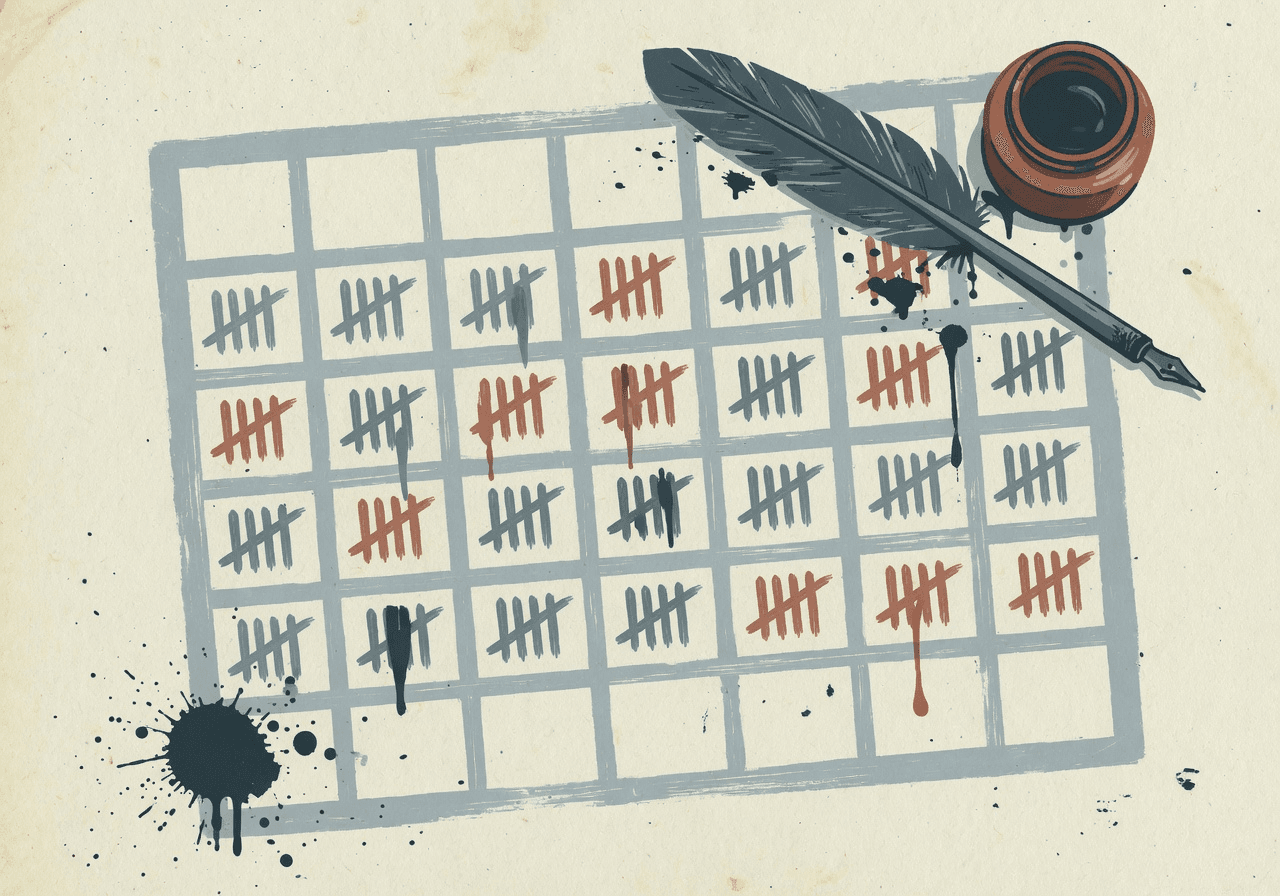
Per Lally and colleagues' 2010 paper in the European Journal of Social Psychology, 96 volunteers chose a daily habit and self-reported their automaticity for 12 weeks. Median time to automaticity: 66 days. Range: 18 to 254 days. Missing a single day didn't significantly impact habit formation. The 66-day finding has displaced the popular "21-day habit" myth in the behavior-change literature; sustained change is real, the timeline varies widely, and the long-tail variation is real too. The Intentional You math in this tool assumes you sustain the behavior across remaining-life weeks. The tool doesn't warn you when your Intentional slider feels ambitious — that would be preaching, and the math is honest enough without it. Most people sustain habits they form. Your call whether to be optimistic.
General tools
Workshop sibling — same SSA actuarial backbone, different function on the data. SDP names your single-year mortality probability; this tool names what you'd do differently with the time.
Money math
Honest-math sibling — base-rate framing of unlikely outcomes vs. the multiplier hiding inside daily habits. Both refuse the over-promise.
Health benchmarks
Behavior-pattern projection cousin — week-by-week patterns vs. multi-decade trajectories. Both ask what your current pattern actually produces.
Privacy
We use PostHog and Google Analytics to understand how the tools are used. No raw inputs ever leave your browser. Bucketed values only.
Card 1
We use the Social Security Administration's Period Life Table 2022, the same actuarial table used in the 2025 Trustees Report. Period life tables use the mortality rates for a single calendar year and project them forward unchanged across your remaining life. This is the standard transparent approach for static consumer tools — every parameter visible, no forward-projection assumptions about future medical or social changes. Cohort life tables exist and project mortality improvements year by year; they produce slightly higher remaining-life expectancies. For consumer-tool transparency we use period. The CDC's NCHS NVSR 74-02 publishes the cross-validation table by race and ethnicity if you want the deeper cut.
Your remaining weeks = e(x) at your age and gender × 52.1775 weeks per year.
A scenario. Not life-expectancy advice.
Card 2
We use the same actuarial data death-clock tools use — Social Security Administration period life tables. The framing is different. Per Burke, Martens, and Faucher's 2010 meta-analysis in Personality and Social Psychology Review — 164 articles, 277 experiments aggregated — explicit mortality reminders (“you only have X weeks left”) measurably produce defensive worldview-clinging in the lab, not mobilizing behavior change. The literal experimental manipulations in mortality-salience research are the phrases that dominate death-clock tools. So we route the mortality data to background — the 52×85 grid sits at 8% opacity behind everything, recognizable but not the product — and surface the comparison instead. The shock that mobilizes change in this tool is the gap between your two trajectories, not the absolute remaining-weeks count. If you want your odds of dying in any single year, see Planimora Stupid Death Probability.
Card 3
Per Lally, van Jaarsveld, Potts, and Wardle's 2010 paper in the European Journal of Social Psychology — 96 volunteers chose a daily eating, drinking, or activity behavior and self-reported their automaticity for 12 weeks — the median time to habit automaticity is 66 days. The range is wide: 18 to 254 days, depending on the behavior and the person. Missing a single day didn't significantly impact habit formation. The popular “21-day habit” myth has been displaced by Lally's 66-day finding in the behavior-change literature. The Intentional You math in this tool assumes you sustain the behavior across remaining-life weeks. That's a real assumption. Most people sustain habits they form; small consistent change does compound. We don't warn you when your Intentional slider feels ambitious — that would be preaching. Your call whether to be optimistic.
Card 4
The life-in-weeks visualization was popularized by Tim Urban's 2014 essay on Wait But Why (“Your Life in Weeks”) and revisited as a cultural framing in Oliver Burkeman's 2021 book Four Thousand Weeks. We owe them the conceptual debt — and we differ. Urban's grid is a single contemplative scene of a life. Burkeman's book is a philosophical essay on time-management for mortals. Where Urban's grid invites you to look at your weeks, this tool asks what you'd do differently with them.
These are cultural references, not sources — they appear in this card only and never as primary research.
Primary sources
SSA Period Life Table 2022 (Trustees Report 2025) · ATUS 2024 (BLS, June 2025) · Brysbaert 2019 reading-rate meta-analysis (J Memory & Language) · Quoidbach et al. 2013 (Science) on the end-of-history illusion.