What moves the result most?
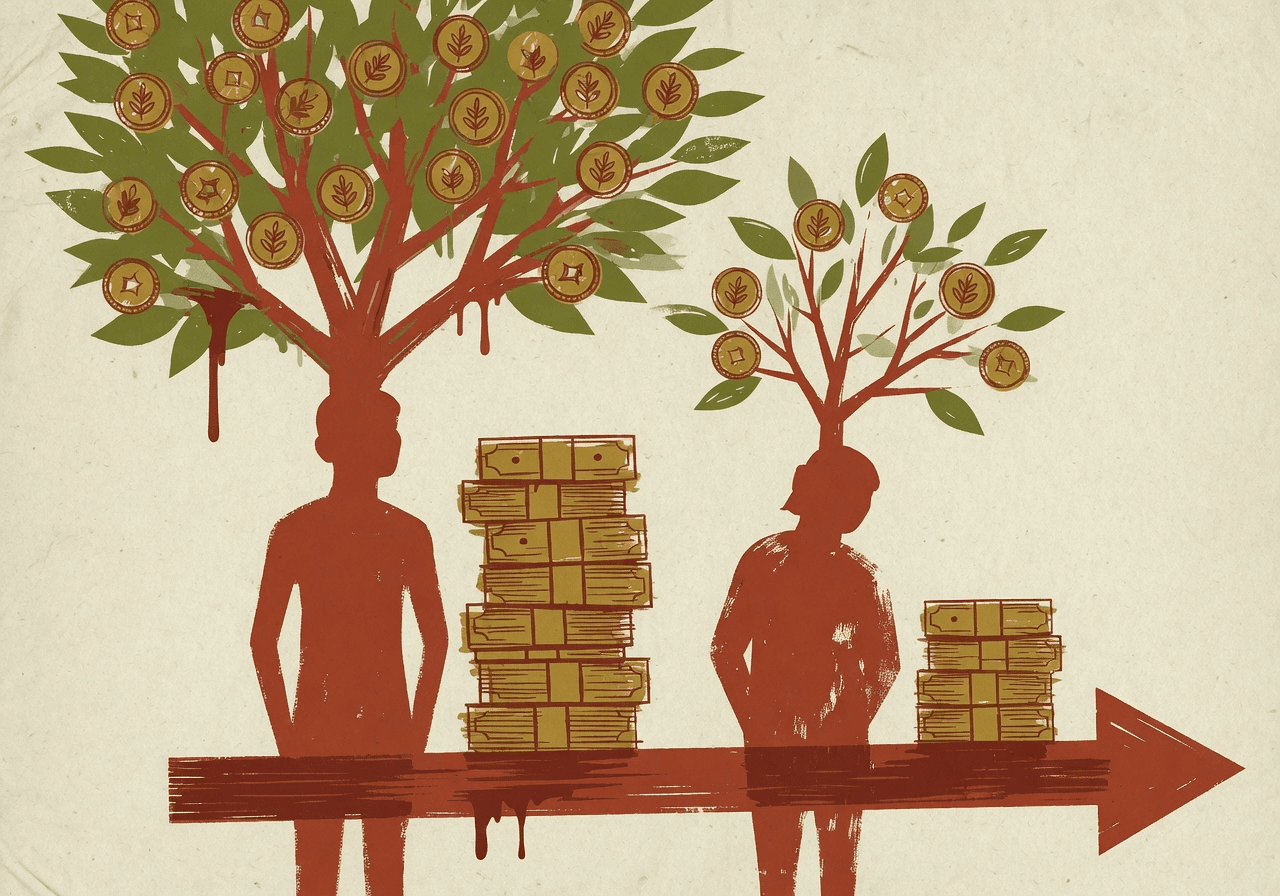
Time bends the curve. $100 a month for 40 years at 8% produces roughly $350,000. The same amount for 20 years produces about $59,000. Doubling the time doesn't double the result — it roughly sextuples it.
Contributions move it proportionally. $200 a month for 30 years at 8% gives you about $300,000 — exactly double the $100 scenario. More in, more out, at the same ratio.
Return rate matters most when time is long. At 10 years, the difference between 6% and 10% on $100 a month is about $1,600. At 30 years, it's about $70,000. Rate amplifies time; without time, rate barely matters.
Change one input and watch the gap.
Why compounding is hard to feel early
There's a well-documented quirk in how people estimate exponential growth. Stango and Zinman (2009) found that most adults underestimate the result of compounding by 30 to 50 percent over long horizons. The academic term is "exponential growth bias."
In year one of $100 a month at 8%, you earn about $53 in interest. By year ten, that annual interest is around $1,400. By year twenty-five, it's over $8,000 a year — from a $100 monthly contribution. The curve doesn't bend where you'd expect it to.
Two friends both save $100 a month at the same rate. One starts at 25 and stops contributing at 35 — ten years, $12,000 total. The other starts at 35 and contributes until 65 — thirty years, $36,000 total. At 65, the early starter still has more money. Not because they saved more, but because their money had a longer runway.
The first decade of compounding looks unimpressive. The last decade does most of the work.
What this can't tell you
This is a formula, not a financial plan. It assumes a fixed annual rate — the same return, every year, for decades. Real markets don't work that way. A bad year early in your timeline costs more than a bad year late (sequence-of-returns risk). The model doesn't capture that.
It also doesn't model taxes. A US 401(k) grows tax-deferred. A taxable brokerage account doesn't. The difference over 30 years can be 20 to 40 percent of your final balance, depending on your bracket and the tax code at the time.
Fees aren't in here either. A low-cost index fund charges around 0.03 to 0.10 percent annually. An actively managed fund might charge 1.0 to 1.5 percent. Over 30 years at 8%, a 1% annual fee reduces your final balance by roughly 25%.
And the model assumes you never stop. You never panic-sell during a downturn. You never skip a month. You never withdraw early. Research suggests the average investor underperforms their own investments by 1 to 2 percent annually — not because they picked wrong, but because they timed wrong.
The math is the easy part.