TL;DR — A dollar does not shrink evenly. It melts fast against some things, slowly against others — and sometimes moves the other way. Enter an amount and a year-range. Watch what the same dollar buys in milk, eggs, gas, gold, Big Macs, Coke, and phone calls.
A 1970s grocery receipt circulates on social media every few weeks: half-gallon of milk, 66 cents. Coca-Cola, a dime. A dozen eggs, 59 cents. The reaction is always the same — "everything used to be so cheap." That sentence treats the dollar as a fixed measuring stick: the items got expensive, the dollar stayed put.
A dollar is not a ruler. It is the thing being measured.
How many gallons of milk did your $10,000 buy?
Pick a number and a year. USDA NASS and ERS Dairy Data track retail whole-milk prices back to 1970. In 1986, a gallon ran about $2.43. By 2026 the same gallon costs roughly $4.10. That's only a ~1.7× nominal climb across forty years — slow next to most headline frames. A $10,000 amount from 1986 bought about 4,119 gallons of milk; the same $10,000 today buys about 2,439 gallons. Measured in milk, your $10,000 from 1986 acts like about $5,922 today. The dollar still lost weight — but more gently than against most other items.
A different stack appears when you swap the chip. Eggs anchored at fifty-nine cents per dozen in 1970, climbed slowly through the 1980s and 1990s, hovered around a dollar through 2000, and then — between 2022 and 2023 — spiked sharply to nearly five dollars per dozen during the avian flu outbreak. They have partially recovered, but not all the way. Long-window readings on eggs are reliable; short-window readings (2020 → 2026) over-report the loss because of the recency anomaly. A thousand-dollar amount from 1980 bought 1,190 dozen eggs at the 1980 price; the same thousand dollars buys 233 dozen in 2026. The delta — 957 dozen eggs — is the same kind of countable arithmetic.
When buying power runs the other way
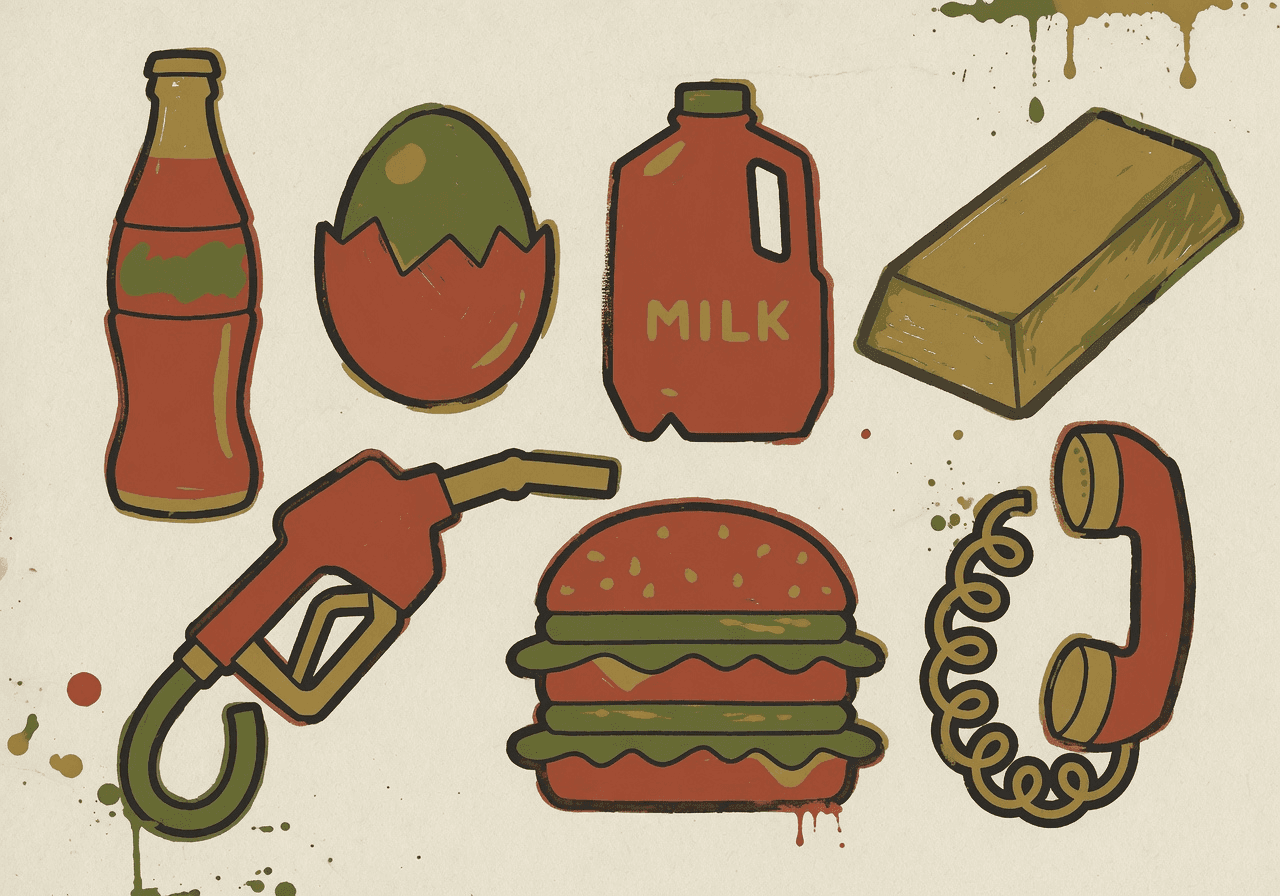
The chip-row across the bottom of the tool holds seven reference frames. Six of them — Coke, Big Mac, Eggs, Milk, Gold, Gasoline — show buying power dropping at different rates over the long window. The seventh chip flips the count.
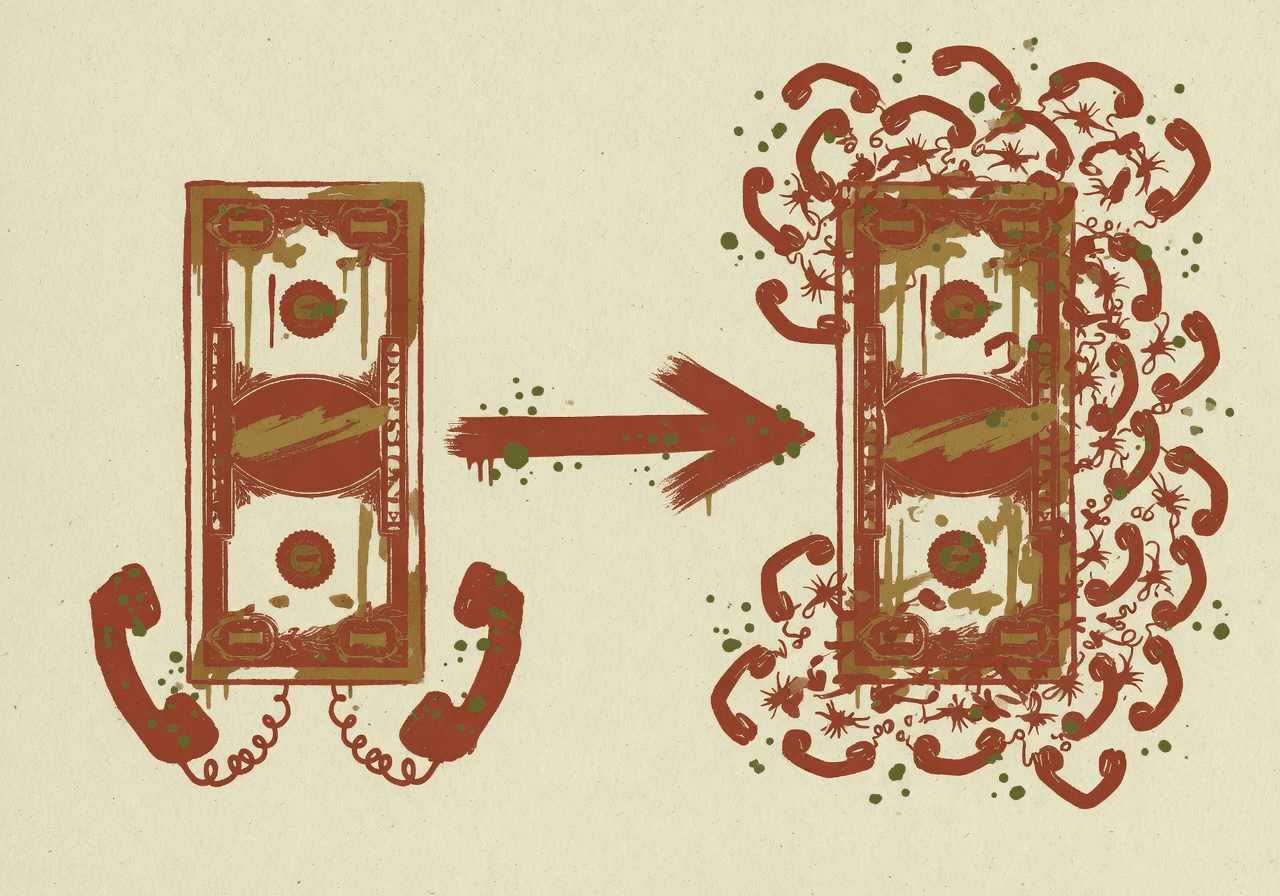
In 1970, a residential long-distance phone call from New York to San Francisco cost roughly forty-five cents per minute on AT&T's regulated daytime rate. The Federal Communications Commission's Industry Analysis Division Reference Book of Rates archives those tariffs back to 1950. A single dollar bought about two minutes of conversation. By 1990, deregulation and the AT&T divestiture had cut the rate to about twenty cents per minute. By 2000, online competition and discount-plan economics pushed it to seven cents. By 2010, the marginal cost approached zero — and on a modern unlimited mobile plan or any voice-over-IP service, the marginal cost of a long-distance minute is effectively zero today.
A dollar in 2026 buys hundreds — modeled at a thousand minutes against a one-tenth-of-a-cent floor — under that same long-distance frame. Measured in phone calls, $1 from 1970 acts like roughly $450 today. The dollar didn't suddenly grow. The unit of consumption restructured. Long-distance billing collapsed under unlimited-plan economics. Either way the count goes the other way, and the chip flips the entire tool's mood with it.
Why some items run faster than others
The general dollar — measured by the BLS Consumer Price Index for All Urban Consumers — lost about 88 percent of its purchasing power against the typical urban basket from 1970 to 2026. That's roughly an 8.2× nominal climb in the average basket. But the average hides the per-item variation.
The measurement: Coca-Cola climbed about twenty times in the same span. A possible interpretation: brand pricing power can lift prices faster than the average without losing buyers, but that's an explanation, not the measurement itself. Milk, by contrast, climbed only about three times — slower than the dollar shrank against the average basket. The dairy supply chain ran more efficient productivity gains than the typical urban basket experienced. Gas climbed about nine times, with volatile years around the oil shocks of 1973 and 1979, the 2008 crash, and the 2022 spike. Big Mac climbed about three to four times since 1986, tracking CPI closely — the canonical purchasing-power-parity benchmark from The Economist's Big Mac Index.
Gold ran on its own track. From 1944 to 1971 the U.S. dollar was pegged to gold at thirty-five dollars per ounce under the Bretton Woods system. In August 1971 the United States ended convertibility, and the gold price floated freely from then on. By 2026 an ounce of gold trades near twenty-six hundred dollars — a roughly 74× nominal climb. That's not a moral statement about gold or fiat currency; it's the measurement the LBMA London Gold Fix archives report. The drill-down on the gold frame says exactly that.
The 2022-23 egg spike is a real number, not a representative one
| Frame (1970 → 2026) | Approx. multiplier | $100 bought (1970) | $100 buys (2026) |
|---|---|---|---|
| Coca-Cola (12 oz) | ~20× | 1,000 Cokes | 50 Cokes |
| Eggs (dozen) | ~7.3× | 170 dozen | 23 dozen |
| Milk (gallon) | ~3.1× | 76 gallons | 24 gallons |
| Gold (oz) | ~74× | 2.86 oz | 0.038 oz |
| Gasoline (gallon) | ~9.2× | 278 gallons | 30 gallons |
| Big Mac | ~3-4× (since 1986) | n/a (pre-1986) | 17 Big Macs |
| Long-distance minute | ~450× (other way) | 222 minutes | 100,000+ minutes |
Compare that to the general dollar weight: a 1970 dollar measured against the urban consumer basket has roughly 12 cents of 1970 purchasing power left in 2026. The general basket sits in the middle of these per-item trajectories — well above milk's gentle climb, well below Coke's brand-pricing curve, far below gold's post-Bretton-Woods detachment, and on the opposite side of the line from long-distance phone calls.
What this tool will not tell you
The comparison is observational, not prescriptive. The tool does not say what you should have done with your dollar instead. It does not project forward into retirement or investment counterfactuals. It does not weight the per-item frames by household budget shares — a personal CPI for your specific spending would land differently from any of the seven chips, and that calculation is outside the scope of one screen.
The Big Mac frame's data begins in 1986 (the year The Economist's Big Mac Index launched); switching to Big Mac auto-clamps the start year up to 1986 rather than fabricating an interpolated guess. The phone-calls frame's 2026 "price" is modeled at a floor because unlimited-plan economics made marginal pricing meaningless; the phone drill-down hedges this explicitly. Short-window readings on eggs and gas distort because of one-off events — 2022-23 avian flu on eggs, oil shocks on gas. Long-window readings (ten years and more) are more reliable for both.
A dollar is a variable. The chip-row lets you pick which variable's coordinate system to read it in. Same currency. Different shrinkage per item. That is the measurement.
Reviewed by Planimora Research · Last reviewed: May 2026 against BLS CPI-U (CPIAUCSL), BLS subindexes (Carbonated drinks, Telephone services, Limited Service Meals), USDA NASS (Eggs, Milk), LBMA Gold Fix, EIA Retail Gasoline Prices, FCC Industry Analysis Division Reference Book + The Economist Big Mac Index data. Updated quarterly. A measurement. Not financial advice.